The year 2026 marks the beginning of the 15th Five-Year Plan period. The Central Economic Work Conference identified eight priority tasks for this year's work on the economy, with "maintaining domestic demand as the main driver of growth and building a robust domestic market" placed at the forefront.
When we look back at 2025, we see that Luzhou has forged a new pathway for integrated cultural, tourism, and commercial development. This is reflected in the iterative upgrades across consumption scenarios from city tourism and the culinary economy to nighttime economic activities, as well as in the vibrant growth of the "ticket stub economy" fueled by music festivals and sports events. The city has progressed from conceptualization to implementation, shifted from isolated breakthroughs toward systematic advancement, and moved beyond the Party committee-led and government-driven initiatives to active public participation. With a noticeable increase in high-impact events, the momentum of converting visitor engagement into tangible consumption growth has become more pronounced. These efforts mark solid strides in establishing Luzhou as a regional consumption hub at the intersection of Sichuan, Chongqing, Yunnan, and Guizhou.
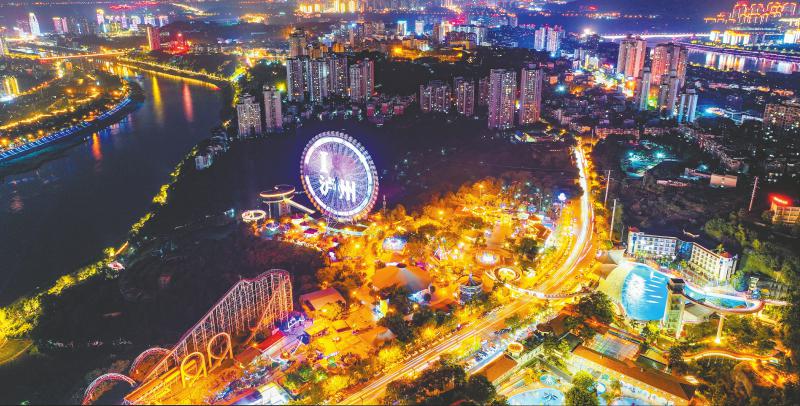
Following this path of integrated cultural, tourism, and commercial development, Luzhou has become a park city for local residents and a "poetry and distant horizon" for visitors from afar. The three sets of metrics—traffic and growth, variables and stock, energy and warmth—vividly illustrate the logic behind Luzhou's integrated cultural, tourism, and commercial development. They also mark clear coordinates for this historical and cultural city to become the "poetry and distant horizon for travelers" in the new era.
Flagship Attractions Draw Visitors: Popularity Drives Consumption Growth
"The Luzhou Music Festival was truly worth it!" "The combination of music festival and fireworks show was spectacular. I'm still savoring the memories…" Even on January 31, more than three months after the Luzhou Galaxy Left Bank Music Festival concluded, user-generated posts on Xiaohongshu continue to be updated, consistently drawing comments such as "I'll definitely go next time!"
This continuously accumulating "long-tail traffic" not only builds momentum for Luzhou's next music festival but also underscores the success of the "flagship attraction" strategy implemented in the previous event.
During the National Day and Mid-Autumn Festival holiday last year, the Luzhou Galaxy Left Bank Music Festival kicked off with a vibrant start. Over three days, it attracted 150,000 young music fans, with more than 88 percent of attendees coming from outside the city and over 50 percent from outside the province. This debut music festival, which gained wide recognition upon its first edition, successfully converted massive visitor traffic into substantial urban consumption growth. According to statistics from the Luzhou Municipal Bureau of Culture, Broadcast-TV and Tourism, the festival generated direct revenue of 65 million yuan, drove over 500 million yuan in peripheral consumption, and stimulated more than 800 million yuan in distal spending such as air tickets and accommodation. It has emerged as a phenomenal event of Luzhou's deep integration across culture, tourism, and commerce.
Behind the breakthrough successes at individual events lies sustained and in-depth cultivation along thematic lines. With music festivals as the driving force, Luzhou has continuously promoted the development of its performance economy, creating a new consumption dynamic where one performance energizes an entire city. The "Gong Xiang Jiu Jiu 2025 Liquor City Yuehang Music Festival" attracted over 30,000 attendees, generating a total tourism expenditure of 22 million yuan in Jiangyang District. Large-scale performance events such as the "Time Classic Concert · Luzhou Stop" and the "Chinese Lang · 2025 An'yi Life Superstar Concert Luzong Stop" were staged in succession. Since 2025, Luzhou has staged four large-scale performance events, each attracting over 10,000 attendees. Cumulatively, these events have drawn more than 180,000 spectator attendances and directly generated over 1.3 billion yuan in associated consumption, positioning the performance economy as a key driver of the city's consumption growth.
The sports event economy has also surged in popularity, emerging as a new engine driving consumption growth in Luzhou. In early 2026, the 3rd AMMA Championship was held in Luzhou. Through this "punch" event, the city has effectively elevated its profile in the sports event economy, infusing new energy into its drive to become a regional consumption hub.
Even before this, Luzhou had already shifted its sports event economy into high gear. In 2025, major sporting events were held successively in Luzhou, including the Guojiao 1573 Luzhou Open 2025, the Boxing &Liquor City · WBA Asia Championship, as well as the 7th National Red City Weiqi (Go) Invitational Tournament, the 20th National Journalists' Tennis Tournament, and the 2025 China Basketball Open Finals. Throughout the year, Luzhou hosted three international-level competitions, five national-level events, and 12 provincial-level tournaments, setting new historical records in both scale and number of events held. These activities directly drove over 700 million yuan in consumption across service sectors such as catering, accommodation, transportation, and retail.
When we look beyond Luzhou at the broader cultural and tourism landscape, regional collaboration has achieved a synergistic effect where the combined outcome exceeds the sum of its parts, thus unleashing greater consumption vitality. Extending westward, Luzhou has comprehensively deepened its cooperation with Yibin. Together, the two cities are co-developing and promoting the cross-regional cultural tourism brand "Visit Yi-Lu, Enjoy the Journey Road" and have conducted joint promotional campaigns in Chongqing and Chengdu, reaching a combined audience of over ten million people. Extending eastward, Luzhou is accelerating the development of the Luzhou-Yongchuan-Jiangjin Integrated Development Demonstration Zone and has jointly hosted multiple cultural tourism promotion events with partner regions. The city has also implemented reciprocal free admission to selected scenic spots in collaboration with areas such as Fuling District in Chongqing, advancing the integration of cultural tourism consumption within the Sichuan-Chongqing region.
Progressing from point breakthroughs to tangible outcomes along thematic lines and finally to area-wide blossoming, the city has consistently turned the sustained visitor traffic into robust consumption growth. In 2025, Luzhou's total retail sales of consumer goods reached 163.35 billion yuan, marking a year-on-year increase of seven percent. The city also set new annual records in both tourist arrivals and total tourism expenditure. The cultural and tourism economy has played an increasingly prominent role in driving the city's overall consumption and enhancing urban vitality. This sector has become a key pillar in stimulating domestic demand and propelling economic development in Luzhou.
A Grand Matrix Retains Visitors: Innovation Variables Activate the Stock of Cultural Tourism
"Holding the freshly bought white rice cake, I take a sip of the special coffee blended with Luzhou baijiu—it's a truly unique flavor. Whenever I bring friends from out of town to Luzhou, this is our first stop," said Li Meng, a university student in Luzhou, smiling as she spoke outside a café in the "Old Luzhou · Dahe Street" historic and cultural district of Jiangyang District on the afternoon of January 30.
"'Old' is precisely Dahe Street's strength. Luzhou is rich in historical relics and cultural heritage. This place carries the memories of countless Luzhou residents. It holds their affection and their nostalgia," said a leading official from the Jiangyang District Bureau of Culture, Broadcast-TV, and Tourism. Once dilapidated old streets are now being rejuvenated as revitalized historic districts through the upgrading of business models and the revitalization of cultural relics, turning them into sought-after "internet-famous destinations" for visitors.
While performance and sporting events demonstrate strong potential in attracting crowds in the short term and drawing visitors from other cities, the key to retaining these visitors lies in a city's foundational strength of cultural, tourism, and commercial resources, as well as its competency in achieving the integrated development of these sectors.
Let's take stock of Luzhou's cultural and tourism endowment. Luzhou is one of the first national pilot cities for cultural and tourism consumption. It is home to a rich tapestry of red culture, Yangtze River culture, baijiu culture, and wellness culture. The city boasts 34 A‑rated tourist attractions, three "Tianfu Tourism Famous Counties", one "Tianfu Tourism Characteristic County", and two nationally certified Class‑B tourist homestays. It has developed 26 new cultural-tourism consumption scenarios and 15 social media-famous check-in spots. The Luzhou Langjiu Town Liquor-Tourism Integrated Cluster has been successfully designated as a national-level nighttime cultural and tourism consumption cluster. A new pattern of all‑for‑one tourism is steadily taking shape.
In recent years, leveraging its distinctive resource strengths, Luzhou has focused on synergistic development across three core pillars: product, industry, and communication.
Within the product matrix, the city integrates resources from the liquor industry, red culture, intangible heritage, and ecological assets to construct four major product systems, while progressively advancing 121 key "culture and tourism plus" projects.
On the industrial front, 22 cultural and tourism projects were signed in 2025 with a total investment of 10.49 billion yuan, providing strong support for high‑quality economic development.
Within the communication matrix, the city has cultivated a flagship music festival IP and leveraged an all‑media matrix to create multidimensional momentum. These efforts have continuously amplified the reach of the city's identity, "Pretty Luzhou, the Liquor City of China—A City that Brews Happiness", attracting a growing number of visitors.
In the process of driving coordinated development across these matrices, how can aging resources be revitalized and new experiences be crafted to truly captivate visitors? Luzhou's answer lies in activating the existing stock of cultural and tourism assets through innovation variables.
Culture is the soul of tourism, and tourism is the vessel of culture. Luzhou has deeply grasped the dialectical relationship between culture and tourism, achieving their integrated development through innovative approaches that "put new wine in old bottles" and "put old wine in new bottles".
"Putting old wine in new bottles" revitalizes classic content by renewing its form. Over the past year, Luzhou has brought millennia-old cultural relics to life through digital technology. The interactive exhibition "Digital Encounters with Sanxingdui &Jinsha Artifacts" drew over 300,000 visits. Zhangba Longan Woods integrated technology with ecology, drawing more than 90,000 attendees to its camping music festival. By leveraging a provincial-level key laboratory for cultural and tourism technology, it has also introduced VR/AR applications at the 1573 National Treasure Cellar Complex, making historical scenes tangible and immersive and ensuring that timeless resources continue to resonate with renewed appeal.
"Putting new wine in old bottles" involves infusing traditional forms with fresh and novel content. In early 2026, the original song "Gaoqiang" from Hejiang County, Luzhou, took the stage on CCTV. By blending traditional elements such as Fubao Gaoqiang mountain songs and Shigong Haozi (stonemasons' work chants) with modern rock, the piece has brought intangible cultural heritage into the spotlight. Meanwhile, the city's cultural and museum IP "Linlin Jiu" has undergone an upgrade: over a hundred cultural and creative products have been developed, exclusive emoji packs released, and traditional crafts like oil‑paper umbrellas and tie‑dyeing integrated into its designs. This fusion allows classical cultural charm to meet modern consumption trends, turning the IP into a must‑have souvenir for visitors.
A Grand Magnet Attracts Visitors: Policy Momentum Fuels the Warmth of Local Life
"Luzhou's cultural and tourism development has entered a new phase characterized by systematic planning and holistic momentum," said the official from the Luzhou Municipal Bureau of Culture, Broadcast-TV and Tourism. This integrated path of cultural, tourism, and commercial development has enabled Luzhou to establish its own unique and irreplaceable position on the regional development map, the official said.
Integration stands as a defining feature of Luzhou's high-quality development in the cultural, tourism, and commercial sectors, driving new progress and positive transformation. The soul of culture, the substance of tourism, and the pulse of commerce are intricately woven together, converging to form a powerful "magnetic field" for Luzhou's cultural and tourism sector. This synergy turns first‑time visitors into repeat guests and transforms fleeting stops into lasting, recurring engagements.
The powerful momentum generated by this magnetic field is fundamentally sustained by the robust drive of "policy energy". Over the past year, Luzhou introduced 19 policies to promote the integration of culture, tourism, and commerce. It also released an Opportunity List for Projects in Major Consumption Landmarks and Characteristic Streets, comprising 184 initiatives with a total planned investment of 67.8 billion yuan. The plans include the construction of the National Baijiu Museum of China, three major urban landmarks, seven distinctive commercial streets, and the cultivation of six key consumption scenarios. Through this unprecedented package of coordinated measures, the city has effectively guided and empowered market entities, thereby stimulating the market's endogenous dynamism.
Policy energy directly enhances the "hard infrastructure" supporting the integrated development of culture, tourism, and commerce. Over the past year, Luzhou has steadily advanced its urban renewal initiatives. The demonstration project for renovating and upgrading the section from the Cultural Plaza at Datibu to the Baizitu Plaza along the First Ring Road has been implemented progressively, while the development of "pocket parks" has flourished across multiple locations. Distinctive consumption landmarks continue to emerge across the city. Old industrial sites such as the Huoju Residential Community and the former Silk Factory in Naxi District have been successfully "awakened", and the revitalized Zhonggulou · Jiangyangli commercial street has quickly become a popular destination for both residents and visitors.
Policy energy also indirectly enhances the city's "soft environment"—its humanistic and cultural fabric. "They arranged shuttle buses, gave me souvenirs, charged only 0.7 yuan per hour for power banks, and set off fireworks for a full ten minutes. Luzhou truly feels like a kindred spirit." During the Luzhou Galaxy Left Bank Music Festival, warm‑hearted residents took the initiative to deliver meals and medicine to music fans and served as caring guides and volunteer drivers for visitors. As hosts of their city, they contributed to and cheered for the event, reflecting the deep sense of pride shared by the people of Luzhou.
This creative way of "spoiling visitors" has long become the norm in Luzhou. Luzhou introduced the "Nine Benefits in the Liquor City" initiative, offering tourists convenience and discounts across nine areas, including baijiu tasting, local cuisine, and public transport. The "Ticket Stub Travel" package allows festivalgoers to enjoy multiple benefits in areas such as accommodation, dining, and tourism discounts by presenting their music festival tickets.
As night falls, policy energy also continues to fuel the warmth and vitality of everyday life. In the streets and alleys, the vibrant landscape of Luzhou's integrated cultural, tourism, and commercial development becomes even more tangible. Distinctive nightlife consumption districts such as Naxi Silk Road 678 · Delicious Era Square and Mountains and Rivers · Bright Moon Drunk City are drawing growing numbers of young visitors. Local specialties like douhua kaoyu (tofu‑grilled fish) and doutang mian (bean‑broth noodles) form a constellation of "midnight kitchens", precisely satisfying the nighttime culinary cravings of travelers. Within the gentle river breeze and the enchanting night scenery, the consumption chain in Luzhou continues to lengthen, stretching ever further.
In 2026, Luzhou is steadfastly advancing toward its goal of building a regional consumption hub. By focusing on three dimensions—integration, innovation, and service—the city is firmly promoting the integrated development of culture, tourism, and commerce, ensuring that more visitors in the new era will "raise a glass and savor the charm of Luzhou", once again giving life to the timeless acclaim: "Where else on earth could rival the splendor of Jiangnan (south of the Yangtze)?"
Where else could truly rival Jiangnan's vitality? Integration holds the key. This year, Luzhou will implement a cultivation project for the integrated cultural-tourism-commerce industrial chain. Efforts will focus on upgrading smart business districts and distinctive commercial streets, building the "Luzhou Cuisine" brand, and enhancing the influence of the China International Alcoholic Drinks Expo and the Global Geographical Indication Products Expo. The city will strengthen the super IP of the "Luzhou Galaxy Left Bank Music Festival", host international events such as the Tennis Open, the China Pickleball Circuit, and marathon races, further develop the "ticket stub economy", and continuously broaden the scope of "culture and tourism +" and "+ culture and tourism" initiatives. Meanwhile, leveraging policy measures to boost consumption, the city will fully unlock consumption potential by creating the "Twelve Delights" consumption theme and organizing 1,000 promotional events under the "Enjoy Benefits in Luzhou" campaign.
Where else could rival Jiangnan's grace? Innovation must be the driving pace. In 2026, through its six themed consumption campaigns—Leisure Stroll, Night Bites, Joyful Shopping, Event Gatherings, Wellness &Fitness, and Green Escapes—Luzhou will comprehensively cultivate new consumption scenarios, so as to transform the city from a transit stop into a deep‑engagement destination. It will strengthen the integration of culture and technology by developing blended products such as 3D‑printed cultural relic reproductions and drone performance shows, while actively promoting new consumption formats like experiential consumption and "IP+" extensions. The city will also advance the smart‑upgrading and experiential transformation of cultural‑tourism venues, better meeting the diverse and differentiated demands of visitors.
Where else could truly rival Jiangnan's warmth? In service lies its growing momentum. In 2026, Luzhou will position service consumption as a key driver for expanding and upgrading consumption and foster new growth areas such as the low‑altitude economy, silver economy, and youth economy. It will pilot the incentivized invoice initiative to enhance consumers' sense of gain and promote more standardized spending practices. Efforts will be made to enhance service quality across the industry, including formulating a renewal plan for Luzhou's homestays, cultivating a distinctive Sichuan‑style Luzhou‑flavored homestay brand, and organizing skills competitions for star‑rated hotels. At the same time, the city will standardize order in the cultural and tourism market, rigorously combat malpractices such as tourism fraud targeting the elderly and forced shopping, and build Luzhou into a city of happiness that delights its residents and attracts visitors from afar.
Hosted by: General Office of the People's Government of Sichuan Province
Website Operation and Maintenance: China Telecom Sichuan Branch
Website Identification Code: 5100000062 Sichuan ICP No. 13001288
Sichuan Computer Information Network and Internet Security Record No. 51010402000507

